

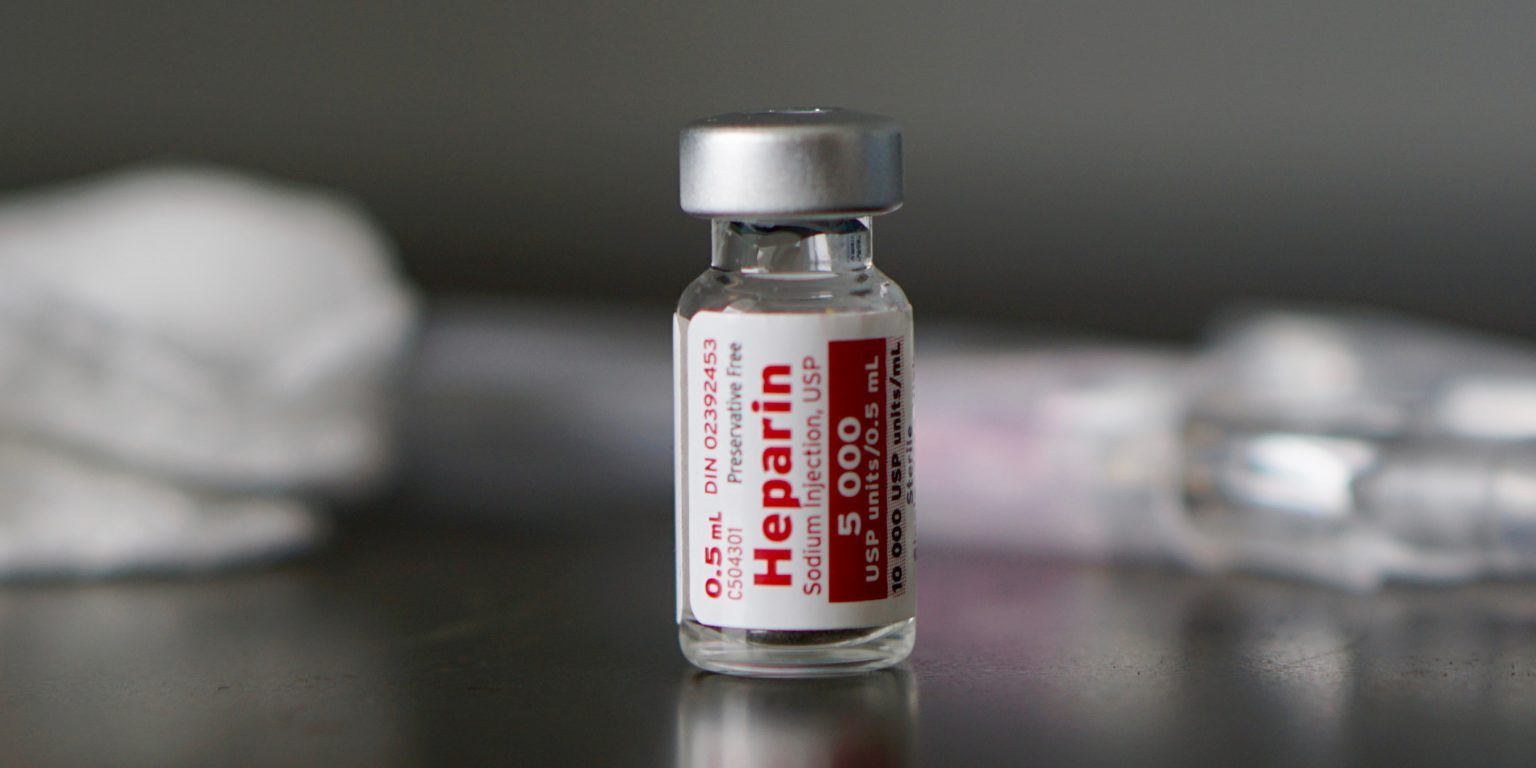
Prepared by Mawlana Dr. Mateen A. Khan MD and Dr. Ramzan Judge, PharmD
Islamic Ruling on Heparin
Summary
Generally, heparin is impermissible when alternatives are available. Permission exists within the Sharīʻah if the treating practitioner, in consultation with a pharmacist, determines that only heparin is viable for the current medical need.
Introduction
Anticoagulants derive their pharmacologic effect by acting at different sites of the coagulation cascade. Some act directly by enzyme inhibition, while others indirectly bind to antithrombin.
Heparin is a naturally occurring anticoagulant indicated for the prevention and treatment of thrombotic events such as deep venous thrombosis (DVT), pulmonary embolism (PE), acute coronary syndrome (ACS), and atrial fibrillation. It binds antithrombin to inactivate thrombin, leading to decreased fibrin. Thus, it prevents the formation of clots and prolongs clotting time. It is commonly used in medical settings as two formulations, unfractionated and low molecular weight heparin (LMWH). Unfractionated heparin is available in intravenous and subcutaneous formulations. LMWH’s (enoxaparin and dalteparin) are available only in a subcutaneous formulation. Medical contraindications to heparin include patients with active bleeding, patients unable to have routine aPTT monitoring, allergic reactions to heparin, or patients with a history of heparin-induced thrombocytopenia.[i]
Sharʻī Assessment
Heparin is sourced only from animal tissue. The primary sources worldwide are porcine or bovine. Currently, the only FDA-approved source of heparin in the US is from porcine intestinal mucosa.[ii] Given its common use in the inpatient and outpatient setting, unfractionated and fractionated heparin pose a significant problem for Muslim patients.
Allah, the Exalted, states:
He has only prohibited for you carrion, blood, the flesh of swine and that upon which a name of someone other than ‘Allah’ has been invoked. (2:173, 5:3, 16:115)
Say, “I do not find, in what has been revealed to me, anything prohibited for anyone who eats it, unless it be carrion, blood that pours forth, or flesh of swine – because it is impure – or there be an animal slaughtered sinfully by invoking on it the name of someone other than Allah. (16:115)
Generally, best-practice medical care requires having competency in religious beliefs and restrictions. This includes informed consent for treatments which may contradict religious beliefs. Whether Muslim or not, medical practitioners should strive to accommodate these restrictions whenever possible.[iii] Further, when something is impermissible in the Sharīʻah, it necessarily entails some level of harm, although the type of harm may be unknown to us. Some Muslim organizations have given blanket approval for the use of heparin. However, their assessment appears shallow and lacks due consideration of actual need (ḍarūrah) and available alternatives.[iv] The intake of porcine-derived products is categorically impermissible (ḥarām). Permissibility is found only when there is strong need and no viable alternative exists, either due to local unavailability or prohibitive cost.[v]
A brief discussion follows of the available medicinal alternatives to unfractionated heparin/LMWH when anticoagulation or DVT prophylaxis is needed. It is not meant to be exhaustive in its assessment.
Alternative medications to heparin:
Oral preparations:
Direct oral anticoagulants (DOACs) – This class of drugs include apixaban, dabigatran, rivaroxaban, and edoxaban.
Subcutaneous preparations:
Fondaparinux
Intravenous preparations:
Argatroban
Bivalirudin
Table 1[vi]:
| Drug | Unfractionated Heparin (IV, SQ) | Argatroban (IV) | Bivalirudin (IV) |
| Source | Porcine | Synthetic | Synthetic |
| Mechanism of Action Target | Factor Xa and IIa | Factor Xa>>> Factor IIa | Reversible direct thrombin inhibitor |
| Onset of Action | Immediate | Immediate | Immediate |
| Metabolism | Reticuloendothelial system | Hepatic (via hydroxylation and aromatization) | Proteolytic cleavage |
| Half-life | Mean: 1.5 hours; Range: 1 to 2 hrs | 39 to 51 minutes; Hepatic impairment: 181 minutes | -25 min (normal renal function) -57 min (severe renal impairment) |
| Monitoring | Anti-Xa or PTT | PTT | PTT |
| Risk of HIT | Yes | No | No |
| Reversal (antidote) | Protamine | No antidote due to short half-life | No antidote due to short half-life |
| Use in Renal Failure | No dose adjustment needed | No dose adjustment needed | -Clearance is reduced by 21% in moderate and severe renal impairment and by 70% in dialysis patients – Dose Reduction needed |
| Drug | Fondaparinux (SQ) | Apixaban (Oral) | Rivaroxaban (Oral) | Dabigatran (Oral) |
| Source | Synthetic | Synthetic | Synthetic | Synthetic |
| Mechanism of Action Target | Factor Xa | Factor Xa | Factor Xa | Direct thrombin inhibitor |
| Metabolism | 77% renally excreted unchanged | 73% hepatic | 1/3 renally excreted unchanged, 2/3 metabolized by CYP3A4/CYP2J2 | 80% renally excreted unchanged |
| Half-life | 17-21 hrs (prolonged in renal failure) | 8-15 hrs | 5-9 hrs | 14-17 hrs |
| Monitoring | Anti-Xa | Anti-Xa | Anti-Xa | None |
| Risk of HIT | No | No | No | N0 |
| Reversal | None | 4-PCC or andexanet alfa | 4-PCC or andexanet alfa | Idarucizumab |
| Use in Renal Failure | Contraindicated if GFR <30 | Dose adjustment needed depending on indication | Dose adjustment needed depending on indication | Contraindicated if CrCl <15 (depending on indication) |
Special Population: Pregnancy
Venous thromboembolic disease in the pregnant population poses a significant challenge. Oral anticoagulants are contraindicated as they have been associated with fetal abnormalities. In this population, fondaparinux SQ may be an option. Although data is limited, experience indicates that it is likely associated with fewer side effects and similar pregnancy outcomes as LMWH. Limited anti-factor X activity was found in placental plasma, but no adverse effects have been reported in the newborns. We encourage the treating specialists to review all available evidence on the use of fondaparinux in pregnancy (some are linked in the references).[vii] We recommend shared decision-making with the patient. If the specialist recommends against fondaparinux or it is precluded due to local unavailability or prohibitive cost, the patient may utilize LMWH as a necessity.
Conclusion
Muslim practitioners and patients should open dialogues about religious restrictions and preferences regarding their medical treatment. The reader should clearly note that appropriate indication and correct medication usage should always be done in consultation with the treating physician and pharmacist. Generally, heparin is impermissible while alternatives exist for it. Permission exists within the Sharīʻah for heparin if the treating practitioner, in consultation with a pharmacist, determines that only heparin is viable for the current medical need.
Muslim healthcare practitioners should also take appropriate steps with their Pharmacy and Therapeutics (P&T) committees to include protocols to accommodate Sharīʻah guidelines.
[i] Warnock LB, Huang D. Heparin. [Updated 2021 Jul 17]. In: StatPearls [Internet]. Treasure Island (FL): StatPearls Publishing; 2022 Jan-. Available from: https://www.ncbi.nlm.nih.gov/books/NBK538247/
[ii] van der Meer JY, Kellenbach E, van den Bos LJ. From Farm to Pharma: An Overview of Industrial Heparin Manufacturing Methods. Molecules. 2017;22(6):1025. Published 2017 Jun 21. doi:10.3390/molecules22061025
[iii] Swihart DL, Yarrarapu SNS, Martin RL. Cultural Religious Competence In Clinical Practice. [Updated 2021 Nov 17]. In: StatPearls [Internet]. Treasure Island (FL): StatPearls Publishing; 2022 Jan-. Available from: https://www.ncbi.nlm.nih.gov/books/NBK493216/
Sadat-Ali, M, Al-Turki, H. The use of porcine derived low molecular weight heparins in Muslims. Saudi Med J 2013; Vol. 34 (8). Available from: https://citeseerx.ist.psu.edu/viewdoc/download?doi=10.1.1.832.54&rep=rep1&type=pdf
Easterbrook C, Maddern G. Porcine and Bovine Surgical Products: Jewish, Muslim, and Hindu Perspectives. Arch Surg. 2008;143(4):366–370. doi:10.1001/archsurg.143.4.366
[iv] https://imana.org/resources/imana-brochure-use-of-heparin/
[v] رد المحتار على الدر المختار، ابن عابدين، دار الفكر (الشاملة)، 1:210
وقيل يرخص إذا علم فيه الشفاء ولم يعلم دواء آخر كما رخص الخمر للعطشان وعليه الفتوى
السابق، 6:389
وفي التهذيب: يجوز للعليل شرب البول والدم والميتة للتداوي إذا أخبره طبيب مسلم أن شفاءه فيه، ولم يجد من المباح ما يقوم مقامه
السابق، 1:233
(قوله أو قول حاذق مسلم) أي إخبار طبيب حاذق مسلم غير ظاهر الفسق، وقيل عدالته شرط
المحيط البرهاني في الفقه النعماني، أبو المعالي برهان الدين، دار الكتب العلمية (الشاملة)، 5:373
فإن الاستشفاء بالمحرم إنما لا يجوز إذا لم يعلم أن فيه شفاءً؛ أما إذا علم أن فيه شفاء، وليس له دواء آخر غيره فيجوز الاستشفاء به؛ ألا ترى إلى ما ذكر محمد رحمه الله في كتاب الأشربة إذا خاف الرجل على نفسه العطش، ووجد الخمر شربها إن كان يدفع عطشه؛ لكن يشرب بقدر ما يرويه ويدفع عطشه، ولا يشرب للزيادة على الكفاية.
البحر الرائق شرح كنز الدقائق، بابن نجيم المصري، دار الكتاب الإسلامي (الشاملة)، 1:122
الاستشفاء بالحرام يجوز إذا علم أن فيه شفاء ولم يعلم دواء آخر اهـ. وفي فتاوى قاضي خان معزيا إلى نصر بن سلام معنى قوله – عليه السلام – «إن الله لم يجعل شفاءكم فيما حرم عليكم» إنما قال ذلك في الأشياء التي لا يكون فيها شفاء فأما إذا كان فيها شفاء فلا بأس به ألا ترى أن العطشان يحل له شرب الخمر للضرورة اهـ.
رد المحتار على الدر المختار، ابن عابدين، دار الفكر (الشاملة)، 6:457
أقول: هذا غير ظاهر، لأن ما يخل العقل لا يجوز أيضا بلا شبهة فكيف يقال إنه مباح: بل الصواب أن مراد صاحب الهداية وغيره إباحة قليله للتداوي ونحوه ومن صرح بحرمته أراد به القدر المسكر منه، يدل عليه ما في غاية البيان عن شرح شيخ الإسلام: أكل قليل السقمونيا والبنج مباح للتداوي، ما زاد على ذلك إذا كان يقتل أو يذهب العقل حرام اهـ فهذا صريح فيما قلناه مؤيد لما سبق بحثناه من تخصيص ما مر من أن ما أسكر كثيره حرم قليله بالمائعات، وهكذا يقول في غيره من الأشياء الجامدة المضرة في العقل أو غيره، يحرم تناول القدر المضر منها دون القليل النافع، لأن حرمتها ليست لعينها بل لضررها.
فتاوی محمودیہ، جامیہ فاروقیہ کراچی، 18:380-386
امداد الفتاوى جديد، دوا میں افیعون، زكريا بك ڈپو انڈیا الھند، 9:257
[vi] Lexicomp app. UpToDate Inc. Accessed March 16, 2022
[vii] Royal College of Obstetricians & Gynaecologists. Reducing the Risk of Venous Thromboembolism during Pregnancy and the Puerperium. Section 8.4. https://www.rcog.org.uk/media/qejfhcaj/gtg-37a.pdf
Royal College of Obstetricians & Gynaecologists. Thromboembolic Disease in Pregnancy and the Puerperium: Acute Management. Section 8.3. https://www.rcog.org.uk/media/wj2lpco5/gtg-37b-1.pdf
American College of Obstetricians and Gynecologists’ Committee on Practice Bulletins—Obstetrics. ACOG Practice Bulletin No. 196: Thromboembolism in Pregnancy. Obstet Gynecol. 2018 Jul;132(1):e1-e17. doi: 10.1097/AOG.0000000000002706. PMID: 29939938.
Pregnancy outcomes and adverse events in patients with recurrent miscarriage receiving fondaparinux versus low molecular-weight heparin: A meta-analysis. Open AccessPublished:May 26, 2023 DOI:https://doi.org/10.1016/j.ejogrb.2023.05.031
Retrospective Analysis of Fondaparinux and Low-Molecular-Weight Heparin in the Treatment of Women With Recurrent Spontaneous Abortion. Front. Endocrinol., 13 October 2021. Volume 12 – 2021. https://doi.org/10.3389/fendo.2021.717630
Dempfle CE, Koscielny J, Lindhoff-Last E, Linnemann B, Bux-Gewehr I, Kappert G, Scholz U, Kropff S, Eberle S, Bramlage P, Heinken A. Fondaparinux Pre-, Peri-, and/or Postpartum for the Prophylaxis/Treatment of Venous Thromboembolism (FondaPPP). Clin Appl Thromb Hemost. 2021 Jan-Dec;27:10760296211014575. doi: 10.1177/10760296211014575. PMID: 33942675; PMCID: PMC8114740.
 muslimmed.org