

by Mawlana Mateen Khan MD and Mufti Adil Farooki MD
Summary: Using a CPAP machine with either a heated humidifier or a heat–moisture exchanger while fasting does not invalidate the fast.
Humidification in Normal Respiration
In unassisted human respiration, ambient air is drawn from the surrounding environment, carrying humidity levels that vary with environmental conditions. Upon inhalation, air enters through the nasal passages or, secondarily, the mouth, and proceeds through the pharynx and trachea into the lungs. Throughout this passage, the respiratory tract progressively warms and humidifies the air before it reaches the lungs. This humidification is achieved through contact with the moist mucosal lining of the upper airway, which adds water vapor to the inspired air without introducing any discrete substance into the body.
Physiologically, inspired air is directed exclusively toward the respiratory system. The esophagus remains closed during breathing, and pressure gradients favor airflow into the trachea and lungs rather than toward the gastrointestinal tract. As a result, inhaled air bypasses the esophagus entirely and does not enter the stomach. This separation between the respiratory and digestive pathways is a fundamental feature of normal breathing and remains operative throughout both inhalation and exhalation.
Within the lungs, air reaches near-total saturation with water vapor. By the time exhalation occurs, expired air approaches 100% relative humidity. This moisture originates from the body itself and represents endogenous water vapor added during gas exchange and airway conditioning. Some of this moisture is naturally retained within the upper airway during the respiratory cycle, contributing to the normal comfort of breathing under physiological conditions.
This baseline mechanism is critical for what follows. Ordinary respiration involves neither the entry of an external, tangible substance nor the conveyance of moisture to the gastrointestinal tract. Rather, it consists of airflow confined to the respiratory system, with humidification occurring as a functional byproduct of mucosal contact and gas exchange. This distinction forms the basis for the next discussion of assisted ventilation, external humidification, and their juristic evaluation.
CPAP Therapy and Methods of Humidification
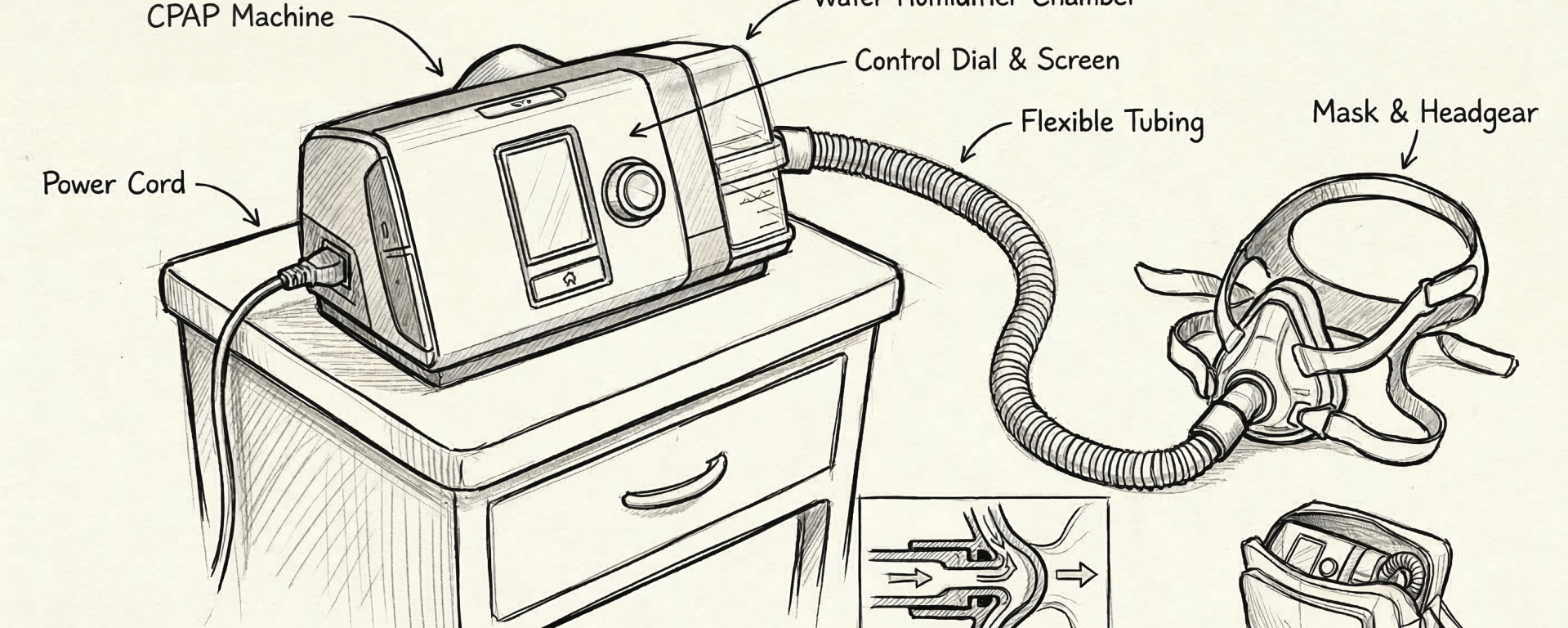
Obstructive sleep apnea is characterized by recurrent collapse of the upper airway during sleep, resulting in impaired ventilation, oxygen desaturation, fragmented sleep, and excessive daytime somnolence. When untreated, it is associated with significant long-term cardiopulmonary morbidity. Continuous positive airway pressure (CPAP) therapy has therefore become a standard and effective treatment. The device functions by delivering a continuous stream of pressurized air, sufficient to splint the upper airway open and prevent collapse throughout the respiratory cycle.
The therapeutic mechanism of CPAP differs from normal breathing in one medically relevant respect: airflow is delivered at higher, more constant pressures and at increased flow rates. The continuous, pressurized airflow delivered by CPAP increases inspiratory flow rates and accelerates evaporation from the nasal and pharyngeal mucosa. At the same time, the altered airflow dynamics reduce the normal recapture of moisture from exhaled air, resulting in a net loss of mucosal hydration. The consequence is commonly experienced as dryness, irritation, and discomfort. To mitigate this effect and improve tolerance, CPAP systems are frequently paired with humidification devices.
Two forms of humidification are commonly employed, each with distinct mechanics but a shared end result.
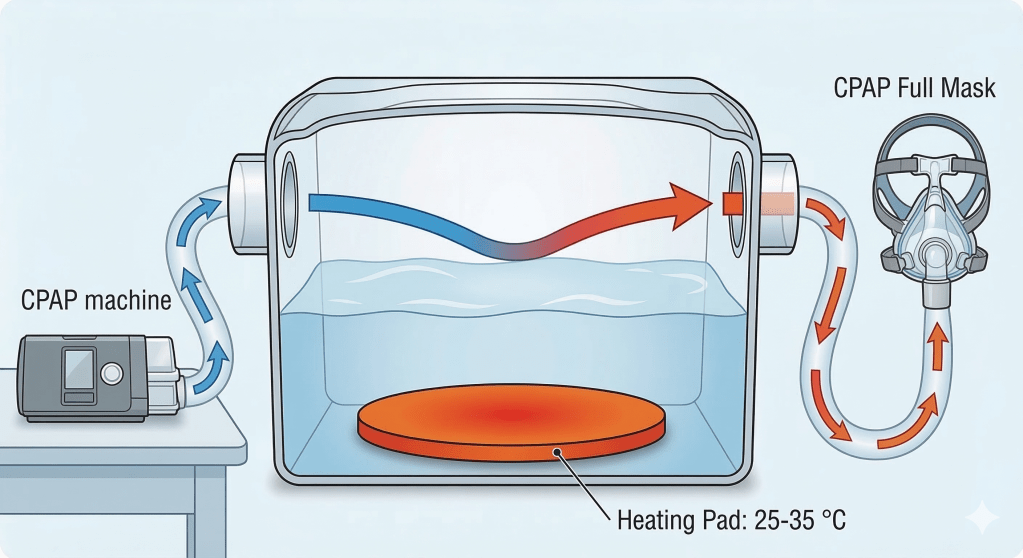
The first is the heated humidifier. In this system, air from the CPAP compressor passes over or through a chamber containing liquid water that is gently heated to a lukewarm temperature, typically 25–35°C, well below the boiling point. Heating increases the air’s capacity to hold water vapor, allowing evaporation to occur. The water is thus incorporated into the airflow exclusively as a gas. In other words, water molecules are a component of the air, no different than oxygen or nitrogen. No liquid droplets are produced, and no visible mist is present. The air delivered through the tubing and mask appears identical to ordinary air, differing only in its higher absolute humidity. This is evaporation-based humidification, analogous in physical principle to environmental humidification of indoor air.
Note: At times, the user may notice condensation in the tubing or mask. This occurs as humidified, warmed air exits the chamber and meets the relatively cooler tubing or mask. Despite this, the air being breathed is still free of an ‘ayn. The condensation may be mitigated by using heated tubing.
The second is the heat–moisture exchanger (HME). This system contains a porous medium, commonly a matrix or treated fabric, positioned in the airflow pathway. During exhalation, the warm, fully saturated air leaving the lungs deposits heat and moisture onto this medium. During the subsequent inhalation, the stored heat and water vapor are released back into the inspired air. In this configuration, there is no liquid water reservoir and no introduction of new water during use; rather, a portion of the patient’s own exhaled moisture is captured outside the body and returned. The exchanger functions as a temporary storage matrix, moderating humidity loss across respiratory cycles.
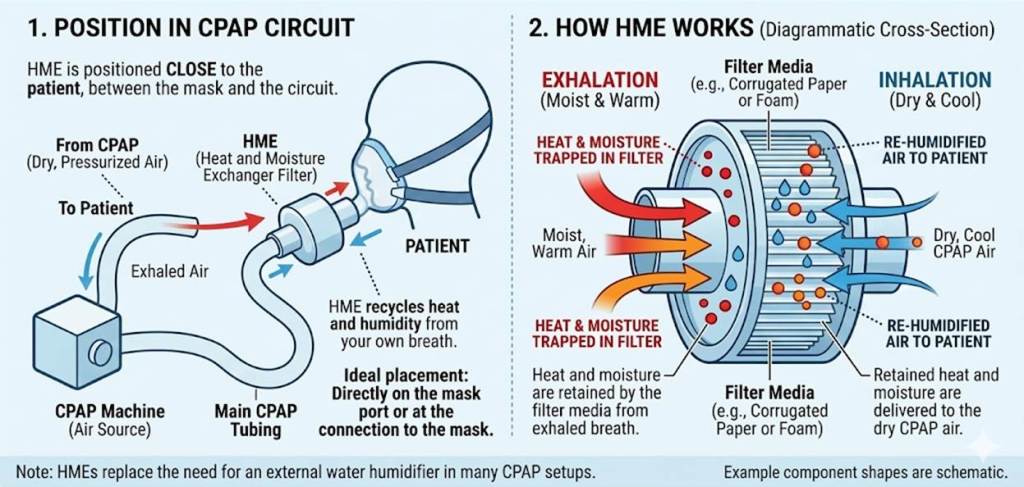
Despite their different mechanisms, both systems share a single functional outcome: they increase the humidity of inspired air without producing aerosolized liquid, perceptible droplets, or particulate matter. In the heated humidifier, moisture originates from an external water chamber and enters the airflow as vapor. In the HME, moisture originates from exhaled breath and is returned from an external exchange medium. In neither case does the patient inhale liquid water or visible mist.
This distinction is critical for subsequent fiqh analysis. Breathing humidified air must not be conflated with the use of inhalers or nebulized medications, in which aerosolized particles traverse the throat and may reach the gastrointestinal tract through deposition and secondary swallowing. CPAP humidification lacks any comparable mechanism of particulate delivery, deposition, or conveyance of a tangible substance to the jawf. The relevance of this difference will become apparent in the fiqh discussion that follows.
Fiqh Application to Humidified CPAP Airflow
Invalidators of the fast
In the Sharīʻah, the invalidation of the fast is not established by mere entry into the body, but by the realization of ifṭār either in form (ṣūratan) or in meaning (maʿnan). The jurists consistently state that the breaking of the fast is established only by its form or its meaning (al-fiṭr lā yathbutu illā bi-ṣūratihi aw maʿnāhu). The form of ifṭār (ṣūrat al-fiṭr) is swallowing (ibtilāʿ), while its meaning (maʿnā al-fiṭr) is the arrival to the interior (jawf) of that which is legally deemed conducive to bodily soundness (mā fīhi ṣalāḥ al-badan), whether as nourishment (taghdhīya), treatment (tadāwī) or something savored (taladhudh). Kaffārah is only entailed where both form and meaning are realized, while the fast itself is invalidated by the presence of either alone, subject to the well-known qualifications set out in the classical texts.[1]
Absence of ṣūrat al-fiṭr
With respect to humidified CPAP airflow, neither the form nor the meaning of ifṭār is realized. As for form, swallowing requires the conveyance of a tangible substance (ʿayn) possessing materiality (jawhar) into the interior. In humidified airflow, no such substance exists. The added moisture is not a discrete entity, but a property (athar) of the air, present in gaseous form rather than as liquid droplets. It lacks separable mass, boundaries, and persistence, and therefore does not constitute an ʿayn capable of being swallowed. Rather, humidity is a property or athar of the air. For example, the jurists cited blackness noted in the spit after the application of kohl not as substance that would break the fast but rather as an athar that would not. Likewise, trace blood dominated by saliva from bleeding in the mouth, the taste of food, drink, or medicine. In this sense, an increase in humidity is more akin to smelling a rose or another scent.[2]
For this reason, humidified airflow is categorically distinct from inhalers, smoke, or dust. In those instances, particulate matter or aerosolized droplets possess materiality, undergo deposition along the upper airway, and are subsequently swallowed, thereby realizing ibtilāʿ and the form of ifṭār. By contrast, water vapor in humidified air lacks a mechanism for deposition and leaves no residue that could be ingested. What passes through the airway is air bearing an imperceptible increase in humidity, i.e., an athar, not a substance entering the throat in a manner susceptible to swallowing.
Accordingly, ṣūrat al-fiṭr is absent in this case.
Absence of maʿnā al-fiṭr
The meaning of ifṭār is likewise not realized. First, as noted, there is no jawhar whose arrival could even hypothetically be evaluated under the category of mā fīhi ṣalāḥ al-badan. The moisture involved remains at the level of athar, not ʿayn.
Second, from a physiological standpoint directly relevant to the fiqh analysis, inhaled air, whether humidified or not, does not reach the stomach. It is directed from the pharynx into the trachea and lungs, while the esophagus remains closed during respiration. If it is claimed that humidified air moistens the mucosa and that some of this moisture may later be swallowed with saliva, such moisture is legally overlooked (maʿfū ʿanhu). This is analogous to the residual moisture that remains after rinsing the mouth or the taste perceived in the throat from substances that were not themselves ingested.
Third, humidified airflow does not provide ṣalāḥ al-badan (that which brings bodily soundness or sustenance) in the recognized juristic sense. This concept is not abstract but refers to a benefit tied to nourishment or treatment, whether actually realized or customarily intended (‘urf). Humidification neither nourishes nor assists digestion, nor is it customarily considered a substitute for eating or drinking, nor does it constitute medicinal intake. Rather, it merely facilitates normal breathing by reducing irritation and preventing excessive dryness in the upper airway. Such facilitation does not amount to tadāwī that affects the fast, for the tadāwī relevant to fasting rulings is confined to the entry of a medicinal substance into the interior in a manner comparable to eating or drinking.[3]
For these reasons, maʿnā al-fiṭr is absent.
Resulting ruling
Given the absence of both form and meaning (no ibtilāʿ of an ʿayn, and no arrival of that which constitutes mā fīhi ṣalāḥ al-badan), the use of CPAP with humidified airflow, specifically a heated humidifier and HME, does not invalidate the fast. The moisture involved is analogous to other cases explicitly addressed by the jurists in which only an athar is perceived without the entry of an ʿayn, and which they ruled as non-invalidating. On this basis, humidified CPAP use remains outside the causes of ifṭār.
Juristic Analogues (Naẓāʾir)
The foregoing analysis is further reinforced by analogues (naẓāʾir), all of which share the features present in humidified CPAP use: the absence of an ʿayn, the presence of only an athar, and the lack of ṣalāḥ al-badan reaching the interior. None of these is considered ifṭār.
1. Another person’s breath
The jurists did not regard inhaling air exhaled by another person, such as during close proximity or kissing a spouse, as invalidating the fast. Although exhaled breath is fully saturated with moisture, what is inhaled remains air bearing humidity as an athar rather than a consumable ʿayn. No swallowing occurs, and nothing reaches the jawf that brings bodily soundness.
2. Breathing through cloth
Placing a cloth or scarf over the mouth and breathing through it likewise does not invalidate the fast. Moisture from exhalation accumulates in the cloth and then evaporates into inhaled air. What enters remains air bearing an athar rather than liquid water or another swallowable ʿayn. This closely resembles the operation of a heat-moisture exchanger.
3. Covering the head or airway
The jurists also did not consider covering the head or airway with cloth or bedding when sleeping to invalidate the fast, even though such coverings trap warmth and moisture from exhaled breath. The resulting humidity is treated as an environmental condition rather than the entry of an ʿayn.
4. Entering a warm shower
Entering a warm bath or shower in which the surrounding air becomes warm and humid has likewise not been treated as invalidating the fast, provided that no visible steam or droplets are inhaled or swallowed. In such cases, the increased moisture remains an athar of the air rather than a discrete ʿayn.
5. Humidifying the surrounding air
Deliberately increasing the humidity of the surrounding air, e.g., operating a room humidifier, does not invalidate the fast. Even when visible vapor is produced at the source, what ultimately reaches the person’s breathing remains ordinary air whose humidity is merely an athar rather than an entering ʿayn.
Juristic Significance
These examples demonstrate a consistent principle in the madhhab: atmospheric or respiratory moisture is not treated as intake. Where only an athar is present and no ʿayn enters the jawf bringing ṣalāḥ al-badan, neither the ṣūrah nor the maʿnā of ifṭār is realized. Humidified CPAP airflow, therefore, falls squarely within an established juristic pattern.
[1] بدائع الصنائع في ترتيب الشرائع، علاء الدين، أبو بكر بن مسعود بن أحمد الكاساني، دار الكتب العلمية، 2:90
وأما ركنه: فالإمساك عن الأكل، والشرب، والجماع لأن الله تعالى أباح الأكل، والشرب، والجماع في ليالي رمضان لقوله تعالى {أحل لكم ليلة الصيام الرفث} [البقرة: 187] إلى قوله {فالآن باشروهن وابتغوا ما كتب الله لكم وكلوا واشربوا حتى يتبين لكم الخيط الأبيض من الخيط الأسود من الفجر} [البقرة: 187] أي: حتى يتبين لكم ضوء النهار من ظلمة الليل من الفجر، ثم أمر بالإمساك عن هذه الأشياء في النهار بقوله عز وجل {ثم أتموا الصيام إلى الليل} [البقرة: 187] فدل أن ركن الصوم ما قلنا فلا يوجد الصوم بدونه.
وعلى هذا الأصل ينبني بيان ما يفسد الصوم وينقضه لأن انتقاض الشيء عند فوات ركنه أمر ضروري، وذلك بالأكل، والشرب، والجماع سواء كان صورة ومعنى، أو صورة لا معنى، أو معنى لا صورة وسواء كان بغير عذر، أو بعذر وسواء كان عمدا، أو خطأ طوعا، أو كرها بعد أن كان ذاكرا لصومه لا ناسيا ولا في معنى الناسي.
فتح القدير، كمال الدين محمد بن عبد الواحد السيواسي المعروف بابن الهمام، دار الفكر، 2:342
الحداية: (ومن احتقن أو استعط أو أقطر في أذنه أفطر) لقوله – صلى الله عليه وسلم – «الفطر مما دخل» ولوجود معنى الفطر، وهو وصول ما فيه صلاح البدن إلى الجوف.
الفتح: (قوله ولوجود معنى الفطر) قد علمت أنه لا يثبت الفطر إلا بصورته أو معناه. وقد مر أن صورته الابتلاع. وذكر أن معناه وصول ما فيه صلاح البدن إلى الجوف فاقتضى فيما لو طعن برمح أو رمي بسهم فبقي الحديد في بطنه، أو أدخل خشبة في دبره وغيبها، أو احتشت المرأة في الفرج الداخل أو استنجى فوصل الماء إلى داخل دبره لمبالغته فيه عدم الفطر لفقدان الصورة وهو ظاهر.
والمعنى وهو وصول ما فيه صلاح البدن من التغذية أو التداوي، لكن الثابت في مسألتي الطعنة والرمية اختلاف، وصحح عدم الإفطار جماعة. ولا أعلم خلافا في ثبوت الإفطار فيما بعدهما. بخلاف ما إذا كان طرف الخشبة بيده وطرف الحشوة في الفرج الخارج والماء لم يصل إلى كثير داخل فإنه لا يفسد. والحد الذي يتعلق بالوصول إليه الفساد قدر المحقنة، قال في الخلاصة: وقلما يكون ذلك اهـ. نعم لو خرج سرمه فغسله ثبت ذلك الوصول بلا استبعاد.
فإن قام قبل أن ينشفه فسد صومه بخلاف ما إذا نشفه. لأن الماء اتصل بظاهر ثم زال قبل أن يصل إلى الباطن بعود المقعدة.
لا يقال: الماء فيه صلاح البدن. لأنا نقول: ذكروا أن إيصال الماء إلى هناك يورث داء عظيما. لا يقال: يحمل قولهم ما فيه صلاح البدن على ماء بحيث يصلح به وتندفع به حاجته وإن كان قد يحصل عنده ضرر أحيانا فيندفع إشكال الاستنجاء. لأنا نقول: قد علل المصنف ما اختاره من عدم الفساد فيما إذا دخل الماء أذنه أو أدخله بقوله لانعدام المعنى والصورة، وذلك إفادة أنه لم يصل إلى جوف دماغه ما فيه صلاح البدن، ولو كان المراد بما فيه صلاح البدن ما ذكرت لم يصح هذا التعليل.
النهر الفائق شرح كنز الدقائق، عمر بن إبراهيم بن نجيم، دار الكتب العلمية، 2:20
(أو ابتلع حصاة أو حديدًا) ولم يقل: أكل لأن الأكل ما يتأتى فيه المضغ والهشم والحصاة والحديد ليس كذلك (قضي) لوجود صورة الفطر (فقط) أي: بلا كفارة لعدم وجود معناه وهو إيصال لما فيه نفع البدن إلى الجوف سواء كان يتغذى به أو يتداوى فقصرت الجناية فانتفت الكفارة
الدر المختار وحاشية ابن عابدين رد المحتار، دار الفكر، 2:403
(قوله: أو ابتلع حصاة إلخ) أي فيجب القضاء لوجود صورة الفطر ولا كفارة لعدم وجود معناه وهو إيصال ما فيه نفع البدن إلى الجوف سواء كان مما يتغذى به أو يتداوى فقصرت الجناية فانتفت الكفارة
المصدر نفسه، 410
أقول: وحاصله أن الخلاف في معنى الفطر لا التغذي لكن ما نقله عن المحققين لا يلزم منه عدم وقوع الخلاف في معنى التغذي ولكن التحقيق أنه لا خلاف فيه ولا في معنى الفطر؛ لأنهم ذكروا أن الكفارة لا تجب إلا بالفطر صورة ومعنى ففي الأكل الفطر صورة هو الابتلاع والمعنى كونه مما يصلح به البدن من الغذاء أو دواء، فلا تجب في ابتلاع نحو الحصاة لوجود الصورة فقط، ولا في نحو الاحتقان لوجود المعنى فقط كما علله في الهداية وغيرها …
ويظهر من ذلك أن مرادهم بما يتغذى به ما يكون فيه صلاح البدن بأن كان مما يؤكل عادة على قصد التغذي أو التداوي أو التلذذ …
ثم كل ما يؤكل عادة مقصودا أو تبعا لغيره فهو مما يتغذى به، وأما غيره فملحق بما لا يتغذى به وإن كان في نفسه مغذيا والدواء ملحق بما يتغذى به لما فيه من صلاح البدن.
[2] مراقي الفلاح شرح متن نور الإيضاح، حسن بن عمار بن علي الشرنبلالي، المكتبة العصرية، 245
“أو دخل حلقه دخان بلا صنعه” لعدم قدرته على الامتناع عنه فصار كبلل بقي في فمه بعد المضمضة لدخوله من الأنف إذا أطبق الفم.
وفيما ذكرنا إشارة إلى أنه من أدخل بصنعه دخانا حلقه بأي صورة كان الإدخال فسد صومه سواء كان دخان عنبرا أو عودا أو غيرهما حتى من تبخر ببخور فآواه إلى نفسه واشتم دخانه ذاكرا لصومه أفطر لإمكان التحرز عن إدخال المفطر جوفه ودماغه وهذا مما يغفل عنه كثير من الناس فلينبه له ولا يتوهم أنه كشم الورود ومائه والمسك لوضوح الفرق بين هواء تطيب بريح المسك وشبهه وبين جوهر دخان وصل إلى جوفه بفعله.
حاشية الطحطاوي على مراقي الفلاح شرح نور الإيضاح، أحمد بن محمد بن إسماعيل الطحطاوي، دار الكتب العلمية، 659
“أو اكتحل ولو وجد طعمه” أي طعم الكحل “في حلقه” أو لونه في بزاقه أو نخامته في الأصح وهو قول الأكثر وسواء كان مطيبا أو غيره وتفيد مسألة الاكتحال ودهن الشارب الآتية أن لا يكره للصائم شم رائحة المسك والورد ونحوه مما لا يكون جوهرا متصلا كالدخان فإنهم قالوا: لا يكره الاكتحال بحال وهو شامل للمطيب وغيره ولم يخصوه بنوع منه وكذا دهن الشارب ولو وضع في عينيه لبنا أو دواء مع الدهن فوجد طعمه في حلقه لا يفسد صومه.
الطحطاوي: “كالدخان” تمثيل للمنفي وهو ما يكون جوهرا
الهدية العلائية لتلاميذ المكاتب الابتدائية، محمد علاء الدين بن محمد أمين عابدين الدمشقي، دار ابن حزم ، 137
لَا يكره دهن الشارب والكحل والحجامة التي لا تضعفه، ولا شم رائحة المسك والورد ونحوه مما لا يكون جوهرا متصلا كالدخان.
المبسوط، محمد بن أحمد بن أبي سهل شمس الأئمة السرخسي، دار المعرفة، 3:142
ألا ترى أن الصائم إذا تمضمض فإنه يبقى في فمه بلة ثم تدخل بعد ذلك حلقه مع ريقه وأحد لا يقول: بأن ذلك يفطره
البحر الرائق شرح كنز الدقائق، زين الدين بن إبراهيم بن محمد، المعروف بابن نجيم، دار الكتاب الإسلامي، 2:294
وكذا الاكتحال، وأطلقه فأفاد أنه لا فرق بين أن يجد طعمه في حلقه أو لا وكذا لو بزق فوجد لونه في الأصح؛ لأن الموجود في حلقه أثره لا عينه كما لو ذاق شيئا، وكذا لو صب في عينه لبن أو دواء مع الدهن فوجد طعمه، أو مرارته في حلقه لا يفسد صومه كهذا في الظهيرية، وفي الولوالجية والظهيرية: ولو مص الهليلج وجعل يمضغها فدخل البزاق حلقه، ولا يدخل عينها في جوفه لا يفسد صومه فإن فعل هذا بالفانيد أو السكر يلزمه القضاء والكفارة، وفي مآل الفتاوى لو أفطر على الحلاوة فوجد طعمها في فمه في الصلاة لا تفسد صلاته
الدر المختار وحاشية ابن عابدين رد المحتار، دار الفكر، 2:395
الدر: (أو دخل حلقه غبار أو ذباب أو دخان) ولو ذاكرا استحسانا لعدم إمكان التحرز عنه، ومفاده أنه لو أدخل حلقه الدخان أفطر أي دخان كان ولو عودا أو عنبرا له ذاكرا لإمكان التحرز عنه فليتنبه له كما بسطه الشرنبلالي.
الرد: (قوله: أنه لو أدخل حلقه الدخان) أي بأي صورة كان الإدخال، حتى لو تبخر ببخور وآواه إلى نفسه واشتمه ذاكرا لصومه أفطر لإمكان التحرز عنه وهذا مما يغفل عنه كثير من الناس، ولا يتوهم أنه كشم الورد ومائه والمسك لوضوح الفرق بين هواء تطيب بريح المسك وشبهه وبين جوهر دخان وصل إلى جوفه بفعله إمداد وبه علم حكم شرب الدخان.
المصدر نفسه: 2:396
(قوله: كطعم أدوية) أي لو دق دواء فوجد طعمه في حلقه زيلعي وغيره. وفي القهستاني طعم الأدوية وريح العطر إذا وجد في حلقه لم يفطر كما في المحيط (قوله: ومص إهليلج) أي بأن مضغها فدخل البصاق حلقه ولا يدخل من عينها في جوفه لا يفسد صومه كما في التتارخانية وغيرها.
عمدة الرعاية بتحشية شرح الوقاية، الإمام محمد عبد الحي اللكنوي، مركز العلماء العالمي للدراسات وتقنية المعلومات، 3:281
وأما في الادهان والاكتحال؛ فلأنه لا يصل فيه شيء إلى الباطن إلا الأثر وإن وصل شيء من الكحل إلى الحلق فمن المسامات، فإنه ليس بين العين وبينه منفذ، والمفطر إنما هو وصول شيء بعينه من منفذ إلى الباطن، ولذا لا يفطر شم العطر ونحوه.
[3] المبسوط للسرخسي، دار المعرفة، 3:93
(قال): وإن دخل ذباب جوفه لم يفطره ولم يضره، وهذا استحسان وكان ينبغي في القياس أن يفسد صومه؛ لأنه ليس فيه أكثر من أنه غير مغذ وأنه لا صنع له فيه فكان نظير التراب يهال في حلقه وفي الاستحسان لا يضره هذا؛ لأنه لا يستطاع الامتناع منه فإن الصائم لا يجد بدا من أن يفتح فمه فيتحدث مع الناس وما لا يمكن التحرز عنه فهو عفو؛ ولأنه مما لا يتغذى به فلا ينعدم به معنى الإمساك، وهو نظير الدخان والغبار يدخل حلقه قال أبو يوسف: – رحمه الله تعالى – وقد يدخل في هذا الاستحسان بصفة القياس فإنه لو كان الذباب في حلقه ثم طار لم يضره، ولو كان هذا مفسدا للصوم لكان بوصوله إلى باطنه يفسد صومه، وإن خرج بعد ذلك، وإن نزل في حلقه ثلج أو مطر فقد اختلف مشايخنا فيه والصحيح أنه يفطره؛ لأن هذا مما يستطاع الامتناع منه بأن يكون تحت السقف؛ ولأن هذا مما يتغذى به
الدر المختار وحاشية ابن عابدين رد المحتار، دار الفكر، 2:395
الدر: (أو دخل حلقه غبار أو ذباب أو دخان) ولو ذاكرا استحسانا لعدم إمكان التحرز عنه، ومفاده أنه لو أدخل حلقه الدخان أفطر أي دخان كان ولو عودا أو عنبرا له ذاكرا لإمكان التحرز عنه.
(قوله: لعدم إمكان التحرز عنه) فأشبه الغبار والدخان لدخولهما من الأنف إذا أطبق الفم كما في الفتح، وهذا يفيد أنه إذا وجد بدا من تعاطي ما يدخل غباره في حلقه أفسد لو فعل شرنبلالية.
 muslimmed.org